

You are using an out of date browser. It may not display this or other websites correctly.
You should upgrade or use an alternative browser.
You should upgrade or use an alternative browser.
Uncle Bill Shakespeare...Alive and Well!
- Thread starter Meanderer
- Start date


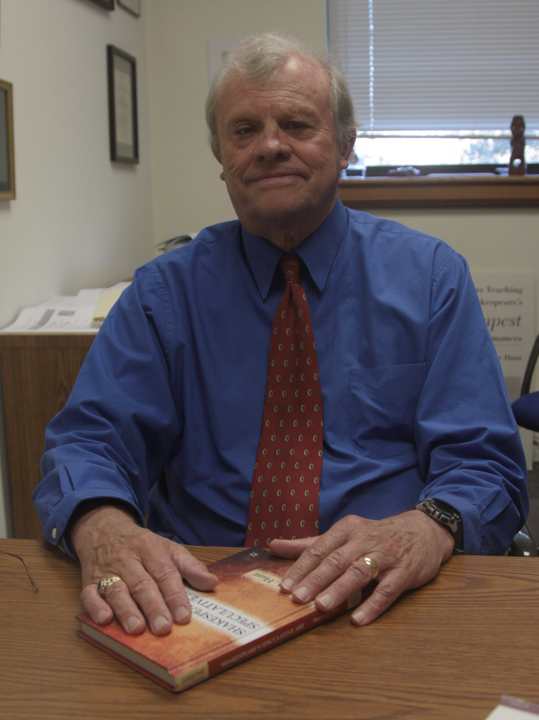
Mirrors are main player in Shakespeare works, writes professor (2011)
“Shakespeare’s Speculative Art,” by Dr. Maurice Hunt, research professor of English at Baylor, was published this summer and examines character development in Shakespeare’s plays through the uses of “specula,” which is the Latin word for mirrors. "READ MORE


horseless carriage
Well-known Member
The BBC are currently running a three part program of Shakespeare's adult life. Part one aired last night, it was called: Rise of a Genius. I found it riveting.
In Shakespeare's Plays, Mealtimes Were A Recipe For Drama
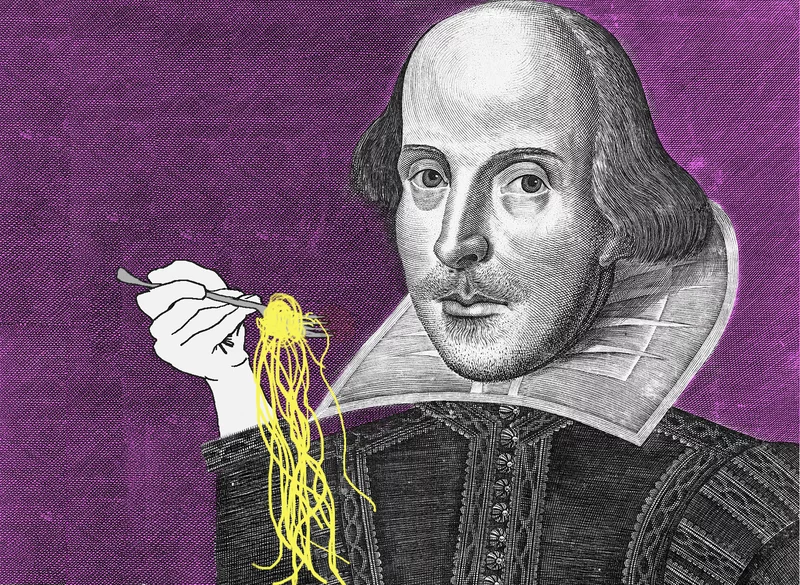
"Anyone who has ever spent Thanksgiving with family knows that the table is a great place for drama. We talk, we shout, we love, we fight — or sit in silence and seethe. And we're all stuck there, gnawing on our turkey legs, playing out our usual roles, unable to just walk offstage."
"That is the very idea William Shakespeare exploited to fill theaters."
"It's difficult to name a play in which Shakespeare doesn't cook up a bit of conflict around the table. It's a good excuse for the playwright to get a lot of people onstage at the same time, to bring friend and stranger together, and to do it all in a close space where the characters have no choice but to talk and interact. And create dramatic tension."
"In The Taming of the Shrew, Petruchio wants to tame the headstrong Katherine, so he steals her away between their wedding and reception, only to starve her into submission over a non-supper at his house. Orlando bursts in on As You Like It's courtly forest feast, setting the wheels in motion for the closing marriage. There's a vanishing meal in The Tempest, the stone soup revenge in Timon of Athens, and the shocking cannibalism of Titus Andronicus. Just to name a few." (READ MORE)

Paco Dennis
SF VIP
- Location
- Mid-Missouri
William Shakespeare, often referred to as “the Bard”, left us with timeless wisdom through his plays and sonnets. Let’s explore some of his poignant quotes on life and death:
- “Cowards die many times before their deaths; the valiant never taste of death but once.” According to the Bard of Avon, those who let their cowardice get the best of them lose a bit of strength every time. It is only those who hold their heads high that stay strong until the end1.
- “And all our yesterdays have lighted fools the way to dusty death. Out, out, brief candle!” In Macbeth, Shakespeare compares life to a “brief candle.” Though it might shine bright, it’s only temporary1.
- “Death, a necessary end, will come when it will come.” As Caesar explains in Julius Caesar, death is inescapable. There is no use worrying about it; we can only live our lives to the fullest until then1.
- “To die, to sleep; To sleep, perchance to dream.” To many, death is compared to sleep. If one is facing struggles in life, death might not be something to be afraid of. Prince Hamlet longs for a dreamless sleep or death1.
- “By medicine life may be prolonged, yet death will seize the doctor too.” Though medicine can keep someone alive for longer, there is no escaping death. Even the doctor will face death as well. The personification of death is a common trope in Shakespeare’s stories1.
- “The undiscovered country from whose bourn no traveler returns.” In Hamlet, death is seen as an “undiscovered country.” Many travelers go to this place, but nobody returns1.
- “Golden lads and girls all must, As chimney-sweepers, come to dust.” Death doesn’t discriminate. From the “golden” lads and girls to the lowly workers, everyone faces death in the end. As the saying goes, ashes to ashes, dust to dust1.
- “When he shall die, Take him and cut him out in little stars, and he will make the face of heaven so fine That all the world will be in love with night.” This beautiful line from Romeo and Juliet speaks of the eternal impact a person can have even after death. Their memory becomes a constellation in the night sky, captivating the world1.


Recently, on PBS...program of his first folio.Recently, on PBS...program of his first folio.

Hey, wait, Horatio didn’t die!
Hamlet prevented Horatio from drinking what was left of the wine that Claudius poisoned, because Hamlet wanted Horatio to tell people his side of the story.Hey, wait, Horatio didn’t die!
Ignore the doubters: here’s why Christopher Marlowe co-wrote Shakespeare’s Henry VI (2016)

"A new edition of Shakespeare’s works has identified Christopher Marlowe as a co-author. The editors of the New Oxford Shakespeare believe that Marlowe collaborated in Parts 1, 2 and 3 of Henry VI. The conclusion was reached on the advice of an “Attribution Board” of three specialists in the field of literary authorship." (READ MORE)

horseless carriage
Well-known Member
Shakespeare’s language has had such an impact on the English language that many phrases from his plays have become part of our common speech, whether we realise it or not.
Media headlines regularly feature Shakespeare quotes. Regular conversations include quotes from Shakespeare plays. In fact, Shakespeare is often quoted without the speaker even realising. In fact, The Oxford Dictionary of Quotations says that Shakespeare wrote about one-tenth of the most quotable quotations ever written or spoken in English.
Here is a list of just a few phrases that appear in Shakespeare’s plays and that are commonly spoken today:
Many of the Common Phrases in Shakespear's plays:
“I have been in such a pickle” - The Tempest
“I must be cruel, only to be kind” - Hamlet
“Laugh oneself into stitches” - Twelfth Night
"For goodness’ sake" - Henry VIII
"Neither here nor there" – Othello
“One fell swoop” - Macbeth
”The be-all and the end-all” - Macbeth
"Mum's the word" - Henry VI, Part II
“All that glisters is not gold” – The Merchant of Venice
"Eaten out of house and home" - Henry IV, Part II
"Knock knock! Who's there?" - Macbeth
"With bated breath" - The Merchant of Venice
“In my heart of hearts” - Hamlet
"Too much of a good thing" - As You Like It
“It’s Greek to me” – Julius Caesar
"A heart of gold" - Henry V
“Break the ice” – The Taming of the Shrew
"Such stuff as dreams are made on" - The Tempest
"Lie low" - Much Ado About Nothing
“I will wear my heart upon my sleeve” - Othello
“Made of sterner stuff” – Julius Caesar
"Dead as a doornail" - Henry VI, Part II
"Not slept one wink" - Cymbeline
"Foregone conclusion" - Othello
"The world's mine oyster" - The Merry Wives of Windsor
"Naked truth" - Love's Labour's Lost
"Faint-hearted" - Henry VI, Part I
"Send him packing" - Henry IV
"Melted into thin air" – The Tempest
"Own flesh and blood" - Hamlet
"Truth will out" - The Merchant of Venice
"Give the devil his due" - Henry IV, Part I
"Though this be madness, yet there is method in't" - Hamlet
"Salad days" - Antony and Cleopatra
"Spotless reputation" - Richard II
"Full circle" - King Lear
"All of a sudden" - The Taming of the Shrew
"Come what, come may" – Macbeth
“Neither rhyme nor reason” – The Comedy of Errors
Surprised? Don't be, there is so much more.

"This book explores fashion during Shakespeare's era, a time when clothing conveyed much more than a personal statement, but was an absolutely accurate indicator of the social status of the wearer, as witnessed in so many Shakespeare plays when character dress, disguise or cross-dressing played pivotal roles in changing plots."
KS3 Drama: Shakespearian characters' costumes
KS3 ShakespeareRosalind(500pix).jpg&f=1&nofb=1&ipt=9ccfe3bde8e710954e5bd3abfa163679711c7528ab59105ac0a78cdb9b17e1cf&ipo=images)
"As male actors played both sexes, costuming was particularly important to distinguish the male characters from the female characters."
"Robin Belfield of the Royal Shakespeare Company explains that it is up to you to decide how you want your character to look."
"He explains that Shakespeare plays can be set in any era; Juliet in ‘Romeo and Juliet’ could be played in traditional Elizabethan dress, in more modern dress or even in very casual clothing, depending on your vision for the part."
"He suggests that a well-chosen accessory or prop can help to define a character."
"He recommends using clues from the text to help define your vision for a character’s costume."
"Robin believes that costume design should involve using your imagination and creativity."
Last edited:


