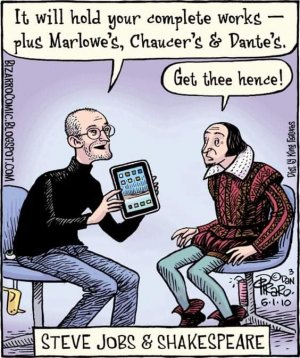
Uncle Bill Shakespeare...Alive and Well!

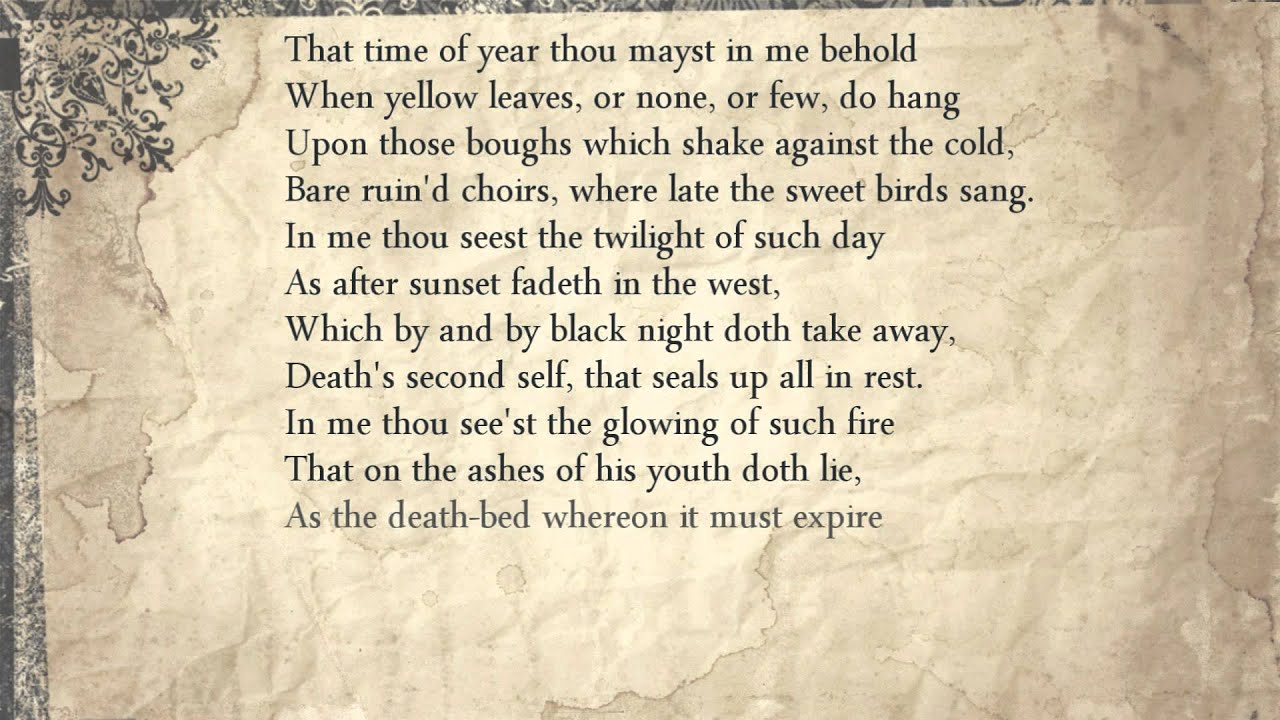
"Sonnet 73, one of the most famous of William Shakespeare 's 154 sonnets, focuses on the theme of old age. The sonnet addresses the Fair Youth. Each of the three quatrains contains a metaphor: Autumn, the passing of a day, and the dying out of a fire. Each metaphor proposes a way the young man may see the poet".
maxresdefault.jpg


Vanessa Redgrave's beautiful rendition of Sonnet 73:


Shakespeare and the Nativist or Americanist movement which led to the infamous Astor Place Riots of 1849:


Reaa60f12e17ce593795f7506ad142102


Astor Place Riot - Wikipedia


The wiki blurb summarizes this series of incidents very well. I used to belong to an American history book club and we explored it even further. You may know of the old Bowery Boys, Dead Rabbits, and other street gangsters who ruled the streets of NYC both in the anti bellum and post bellum periods. For some reason Nativist gangs took it upon themselves to declare Shakespeare an American. As such, only American actors were to portray the major characters. When a play director decided to hire a British actor to portray MacBeth, the Nativists declared war on that director and his theater. Big violence took place. A century later when walking along Astor Place, I could almost swear that I felt the energy of those people as I walked the streets of the East Village in Manhattan.
 
Shakespeare In Love - Bard on the Beach

Based on the screenplay by Marc Norman & Tom Stoppard Adapted for the stage by Lee Hall | Music by Paddy Cunneen
Review
 
iu


"Shylock is a character in Shakespeare’s The Merchant of Venice".

"There were not many Jews in Elizabethan London but those that were there did not have a comfortable time. They were outcasts and suffered extreme discrimination. Not many ordinary people had ever encountered a Jew and when playwrights put Jewish characters on the stage they presented them as villains. Audiences hissed and booed and threw things at the actors who played them". (Continue)
 

Where are the Mothers in Shakespeare?

"In Shakespeare’s time the mother was the family member principally involved with her children’s education and upbringing. Yet in the drama of the period, older women were rarely represented on-stage in what would obviously be one of their more sympathetic roles: that of the loving and nurturing mother".

"This lack is partly explained by the fact that women were not allowed to perform on the English stage: all of the female roles were played by young boys before their voices broke, so that a younger character part was obviously a better physical and vocal match for a boy".
 

10 Shakespearean Terms Of Endearment (link)​


Lambkin​

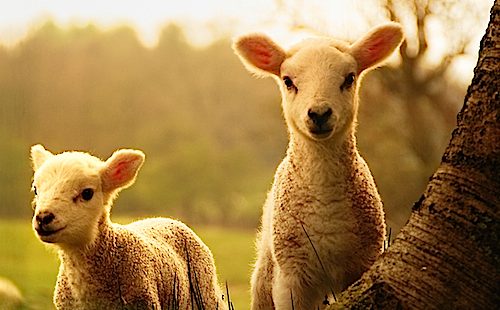
"When lamb isn’t enough of a diminutive, try lambkin. Used lovingly to refer to a person who is exceptionally sweet, young and innocent, this is the ultimate warm and fuzzy pet name. The Oxford English Dictionary attributes the first two recorded citations of lambkin to Shakespeare in Henry IV, Part 2 and Henry V, both from 1600. In Henry IV, Part 2 Pistol breaks the news of the king’s death with the following line: “Sir John, thy tender lambkin now is king.”
595f55b1ef0a2-4110-7960041-29-500x310.jpg
 

Ian McKellen suggests why film actors don't always look the most naturalistic on stage.
 
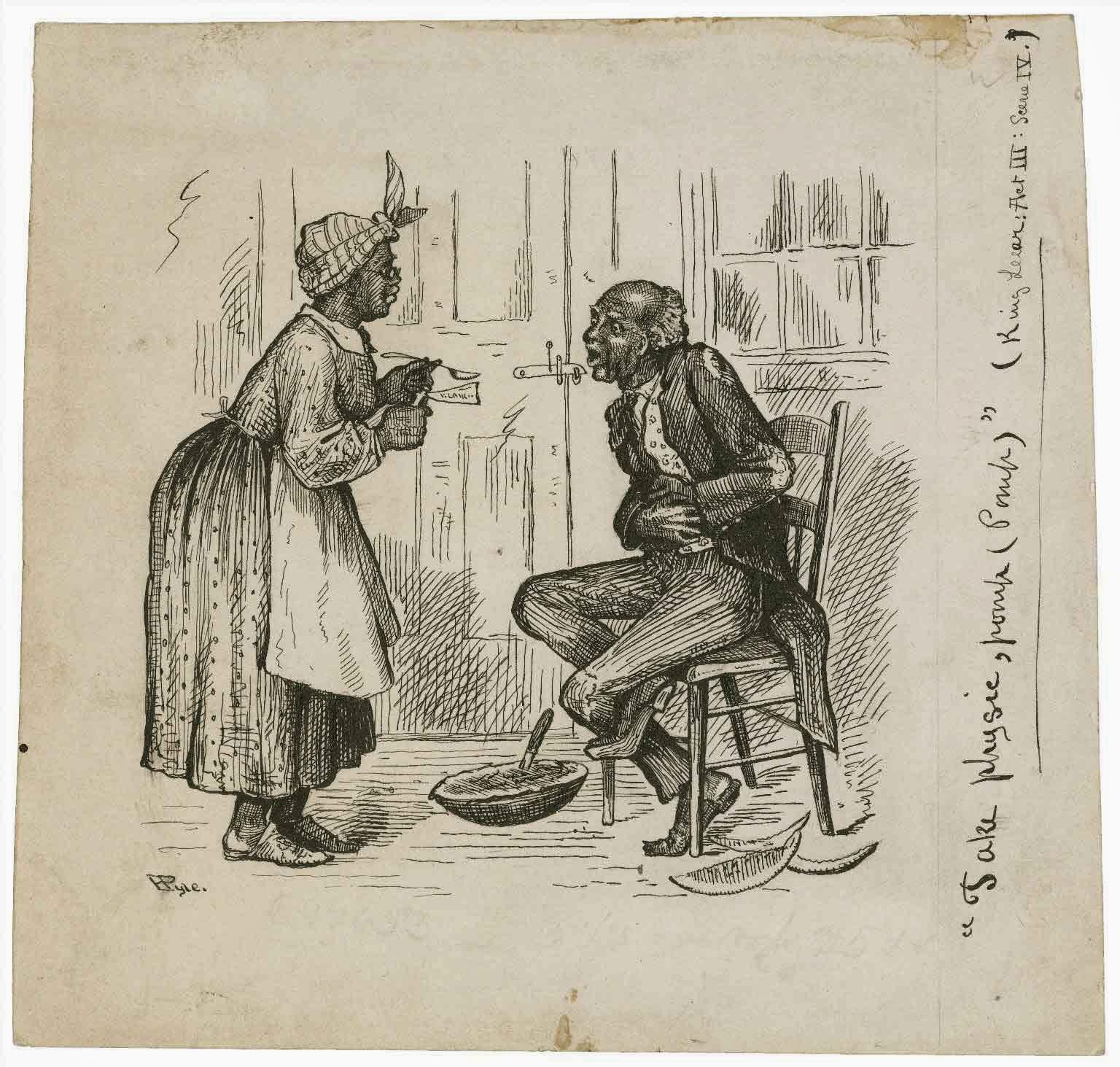
Another picture - so stylistically close to these that Howard Pyle most likely made it at about the same time - was printed in the July 1877 issue of Scribner’s Monthly with the vague title, “A Quotation from ‘King Lear’”.

The original pen-and-ink was, I thought, last heard of when it was sold at auction by Scott & O’Shaughnessy in New York City on April 27, 1916. But, in poking around online, I came across it, semi-misidentified - but viewable here in a nice, high-resolution scan - in the collection of the Folger Shakespeare Library in Washington, DC.
1877.KingLear.original.web.jpg

The extended quote, by the way, is from Lear himself and goes:

Poor naked wretches, whereso’er you are,
That bide the pelting of this pitiless storm,
How shall your houseless heads and unfed sides,
Your loop’d and window’d raggedness, defend you
From seasons such as these? O, I have ta’en
Too little care of this! Take physic, pomp;
Expose thyself to feel what wretches feel,
That thou mayst shake the superflux to them,
And show the heavens more just.

(comment)
kev ferrcoara said...

This is quite interesting.

"The Lear quote is about experiencing hardship to give yourself a more empathetic sense of what the less well-off go through. And by that knowledge, to realize that the "heavens" are unjust. So, to right things, it behooves us to give the excess goods we accumulate to the less fortunate. A basic christian plea for charity".

Pyle seems to be making a parallel between the line about taking medicine (physic) so to become more empathetic to the plight of the unfortunate, to the ability of the black character in the image to take real medicine himself. Pyle seems to be saying of the black man "he is sick just as you get sick, so have empathy. For he must be a man just as you are a man. So give him the medicine he needs."

"This is much more of an editorial cartoon than a joke cartoon, obviously. And it presumes a strong familiarity for Shakespeare among its readership, probably justified".

"The editors' decision to remove the exact quote to replace it with the vague "a quote from King Lear" turns the cartoon into more of a puzzle to solve. I suppose the idea would be the fun of remembering the "take physic" line and applying it to the circumstance portrayed by the cartoon, of the giving of medicine.

"But I wonder if, in doing this, they have negated Pyle's presumed message, to give charity to the poor minority, for they are like us, see"?

"This is assuming I have Pyle's intentions right. It could after all be simply an immature comic statement of the one line in Lear being transposed to such blighted circumstances as the characters shown live within. It really depends on what Pyle social consciousness was understood to be at that time. Pyle was certainly capable of the wittier, editorial version, rather than the simple transposition of the haughty line into low circumstance".
 
The Wild Goose Chase
animal-problem-words-wild-goose-chase-5817-870973dae47355f62d4d3e68ab4657fe@2x.jpg

This phrase is old and appears to be one of the many phrases introduced to the language by Shakespeare. The first recorded citation is from Romeo and Juliet, 1592:

Romeo: Switch and spurs, switch and spurs; or I'll cry a match.
Mercutio: Nay, if thy wits run the wild-goose chase, I have done, for thou hast more of the wild-goose in one of thy wits than, I am sure, I have in my whole five.


Our understanding of the term differs from that in use in Shakespeare's day. The earlier meaning related not to hunting but to horse racing. A 'wild goose chase' was a race in which horses followed a lead horse at a set distance, mimicking wild geese flying in formation.

The equine connection was referred to a few years before Shakespeare's usage, in Gervase Markham's equestrian instructional manual A Discource of Horsmanshippe, 1593. Markham describes the rules of the race at length, the essential point being that the horses follow each other like geese in flight:


"The Wild-goose chase being started, in which the hind∣most Horse is bound to follow the formost, and you hauing the leading, hold a hard hand of your Horse, and make hym gallop softly at great ease, insomuch, that perceiuing your aduersarie striue to take the leading from you, suffer him to come so néere you, that his Horses head may wel nye touch your Horses buttocke, which when you sée, clappe your left spurre in your horses side, and wheele him suddainlie halfe about on your right hand, and then take him vp againe, till such time that he be come to you againe: thus may you doo of eyther hand which you will, and in neuer a one of these turnes, but you shall throw him that rides against you, at least twenty or thirtie yardes behind you, so that whilst you ride at your ease, he shal be forst continually to come vp to you vpon the spures, which must wearie the best Horse in the world. Also in thys match, gette your law in the Wild-goose chase, which is most vsually twelue score to bee twentie score, that if your aduersary chaunce to haue more spéede then you, yet with your truth and toughnes, you may reco∣uer him: for that Horse that lets another ouer-runne hym twenty score at the first in a wild-goose chase, it is pyttie he should euer be hunter".

 
Last edited:
Had the Complete Works somewhere once but couldn't understand it then and wouldn't understand it now, must say something about my IQ level. :)
 
Expectation is the root of all heartache.
William Shakespeare

Heartache wasn't around in The Bard's day, what he actually said was:
"Oft expectation fails, and most oft there where most it promises."
It's from: "All's Well That Ends Well."
So now you know.
 
Back
Top